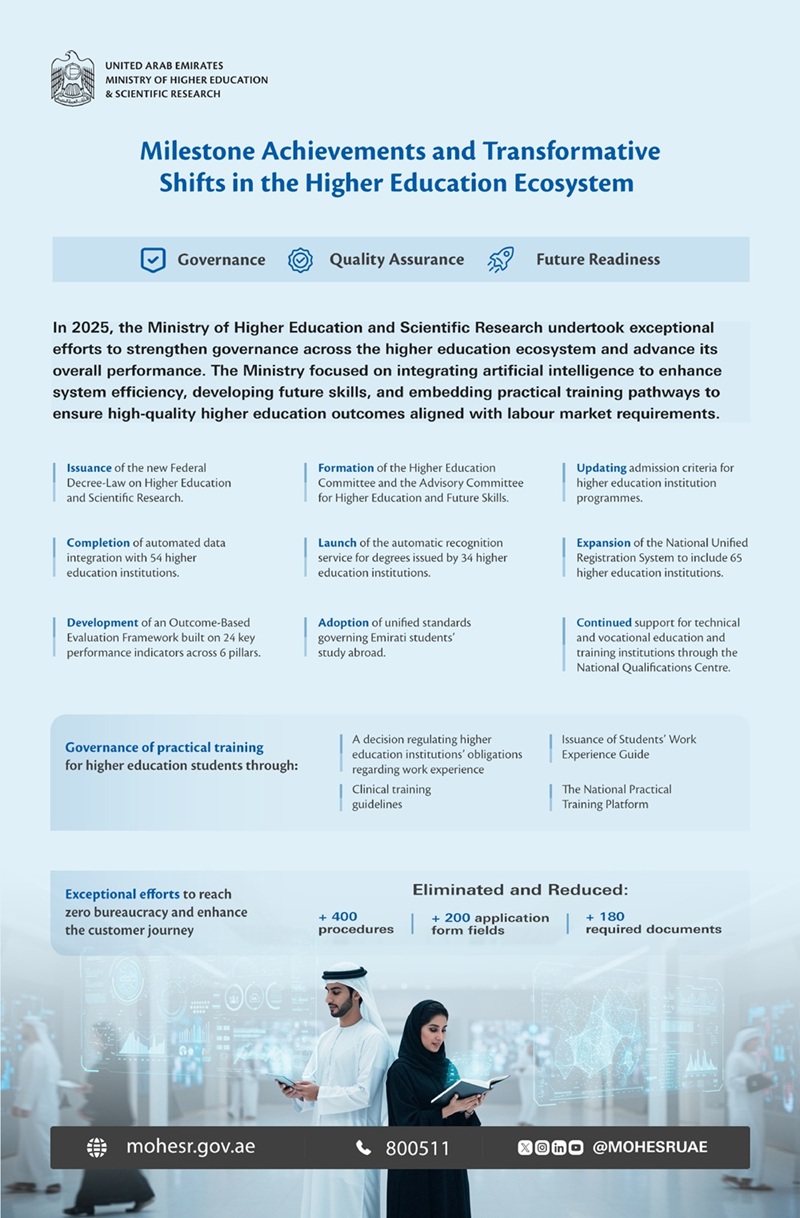
In 2025, the UAE’s higher education and scientific research system reached a defining milestone when the Ministry of Higher Education and Scientific Research (MoHESR) shifted from design to full-scale implementation, driving institutional transformation through a clear roadmap focused on quality outcomes, alignment with national priorities, strong governance and adherence to international standards.
MoHESR’s efforts form part of a comprehensive national strategy to build a future-ready, agile higher education system. Anchored in strategic partnerships with higher education institutions (HEIs), enhanced student experience and strengthened regulatory frameworks, the strategy aims to boost the UAE’s global competitiveness, empower national talent for the evolving labour market and contribute to advancing a knowledge-based economy.
Federal-Decree Law on Higher Education and Scientific Research: A legislative framework for the next phase
At the end of 2025, the UAE Government issued a Federal Decree-Law on Higher Education and Scientific Research, establishing a comprehensive framework to regulate higher education and technical and vocational education and training (TVET), strengthen governance and elevate quality and competitiveness across the sector.
The Decree-Law marks a pivotal step in institutional reform and signals the transition to full implementation during this year. The focus now shifts to translating the Decree-Law into effective policies and operational practices that enhance quality, advance lifelong learning and empower national talent to drive sustainable national development.
Specialised committees to align policy and set priorities
The Education, Human Development and Community Development Council (EHCD) approved the formation of the Higher Education Committee, chaired by His Excellency Dr. Abdulrahman Al Awar, Minister of Human Resources and Emiratisation and Acting Minister of Higher Education and Scientific Research. The committee will align higher education and research strategies with sector outcomes and evolving labour market requirements.
To strengthen system-wide integration, the Ministry also established the Advisory Committee for Higher Education and Future Skills. Comprising academic leaders, key economic stakeholders and research representatives, the committee reinforces alignment between higher education outcomes and national development priorities.
Since its establishment, the Advisory Committee has launched eight working groups focused on strategic and future sectors across the country: the Health Sciences Group; the Artificial Intelligence in Higher Education Group; the Economic Sectors and Higher Education Partnerships Group; the Future of Jobs and Skills Group; the Workforce Supply and Demand in Public and Higher Education Group; the Legal Competencies Development Group; the Drone Skills Group; and the National Competencies Enhancement Group.
Qualitative digital transformation and proactive services
In 2025, MoHESR completed automated data integration with 54 HEIs, advancing a national data-driven agenda to inform policymaking, enhance the student journey and improve service quality and efficiency.
To accelerate proactive service delivery, the Ministry introduced automatic recognition of degrees issued by 34 UAE-based HEIs, with plans to expand coverage to additional universities and to students with degrees issued from outside the UAE.
Streamlining the student journey and redesigning services
In 2025, MoHESR placed the student journey at the centre of reform, recognising it as key to academic success and workforce readiness. Several flagship initiatives were delivered, including – but not limited to – upgraded versions of the National Unified Registration System and the Scholarship Application service.
The redesigned system reduced required documents and data fields by 86%, cut processing times by up to 75% and lowered applicant input by 70%. It also expanded affiliated institutions from 14 to more than 65, achieving a service satisfaction rate of nearly 90%.
In parallel, the Ministry advanced its service modernisation in line with the Zero Government Bureaucracy Programme, undertaking a comprehensive redesign of its digital services. The initiative aims to streamline procedures, accelerate processing times and elevate the overall quality and efficiency of the customer journey.
To enhance customer experience and digital service quality, the Ministry eliminated more than 400 redundant procedures and reduced service application fields by more than 200, simplifying digital forms and making services faster, clearer and more efficient.
MoHESR also removed the requirement to submit more than 180 documents, which are now verified automatically through AI-enabled systems and electronic integration with government entities and HEIs. Additionally, procedural steps were cut from 207 to 84.
The redesign of institutional licensing and academic programme accreditation services stands out as a clear example of the Ministry’s efforts to achieve zero bureaucracy. As a result of the redesign, documentation for new programme accreditation was reduced from 13 documents to one; steps were cut from 13 to three; completion time dropped from six months to just seven days; and site visits were eliminated. These enhancements led to the accreditation of more than 850 new academic programmes under the improved system, achieving 60% growth in less than a year. Additionally, more than 25 new HEIs were licensed and accredited.
Institutional and programme accreditation services for TVET were significantly enhanced, with delivery time reduced by 80%. Institutional accreditation timelines were shortened from 60 to 10 working days, while programme accreditation was reduced from 30 to just five working days.
Outcome-Based Evaluation Framework: A transformative shift in evaluation
To elevate system quality, MoHESR introduced an Outcome-Based Evaluation Framework (OBEF), marking a strategic shift from input-driven evaluation to a model centred on learning outcomes and skills attainment.
The framework features 24 key performance indicators across six pillars: employability, learning outcomes, partnerships, research outcomes, reputation and community engagement. It strengthens transparency, enables evidence-based decision-making and reinforces data governance and integrity.
Partnerships and collaboration with higher education institutions
In 2025, MoHESR strengthened collaboration with UAE-based higher education institutions by streamlining institutional licensing and programme accreditation, enhancing governance, monitoring compliance and granting universities greater flexibility in admission policies, thereby boosting programme quality and operational efficiency.
To support this, the Ministry issued two key ministerial decrees, one on admission criteria and one on institutional licensing and programme accreditation, and conducted interactive workshops with higher education institutions to ensure effective implementation.
Enhancing the Scholarship Programme and governing Emirati students’ study abroad
In 2025, MoHESR redesigned the Scholarship Programme to align with national priorities and labour market needs, shifting from purely funding scholarships to forging partnerships with universities and employers to support students throughout their studies.
The Ministry partnered with eight key national economic institutions from different sectors to design programmes that enhance graduate readiness and employability.
To ensure quality and relevance of studying abroad to national priorities and labour market needs, unified standards were introduced to govern Emirati students’ study abroad, requiring universities and programmes to be included in accredited international rankings according to specialisation and country of study.
Work Experience: establishing a national framework
In 2025, MoHESR prioritised developing a national work experience system to strengthen students’ readiness for the labour market and bridge academic learning with hands-on experience.
The Ministry launched the Work Experience Guidelines for higher education students, providing a unified framework that defines the roles of institutions, training providers and students, while enhancing oversight, evaluation and quality assurance to prevent superficial practices.
Complementing earlier policies, the new framework positions work experience as a core element of higher education, linking educational outcomes to professional development.
At implementation level, the Ministry – in partnership with the Ministry of Human Resources and Emiratisation and the Emirati Talent Competitiveness Council – introduced the National Practical Training Platform within the Nafis system, a digital hub connecting students with quality training opportunities and enabling employers to offer positions meeting approved standards.
Continuous development of TVET system in the UAE
In 2025, the National Qualifications Centre at MoHESR continued supporting technical and vocational education and training (TVET) institutions to deliver advanced programmes across all specialisations in line with national priorities and labour market needs.
These efforts increased the number of accredited TVET institutions, enhancing individual and institutional efficiency, competitiveness and professional development, while improving overall institutional performance and the quality of outputs.