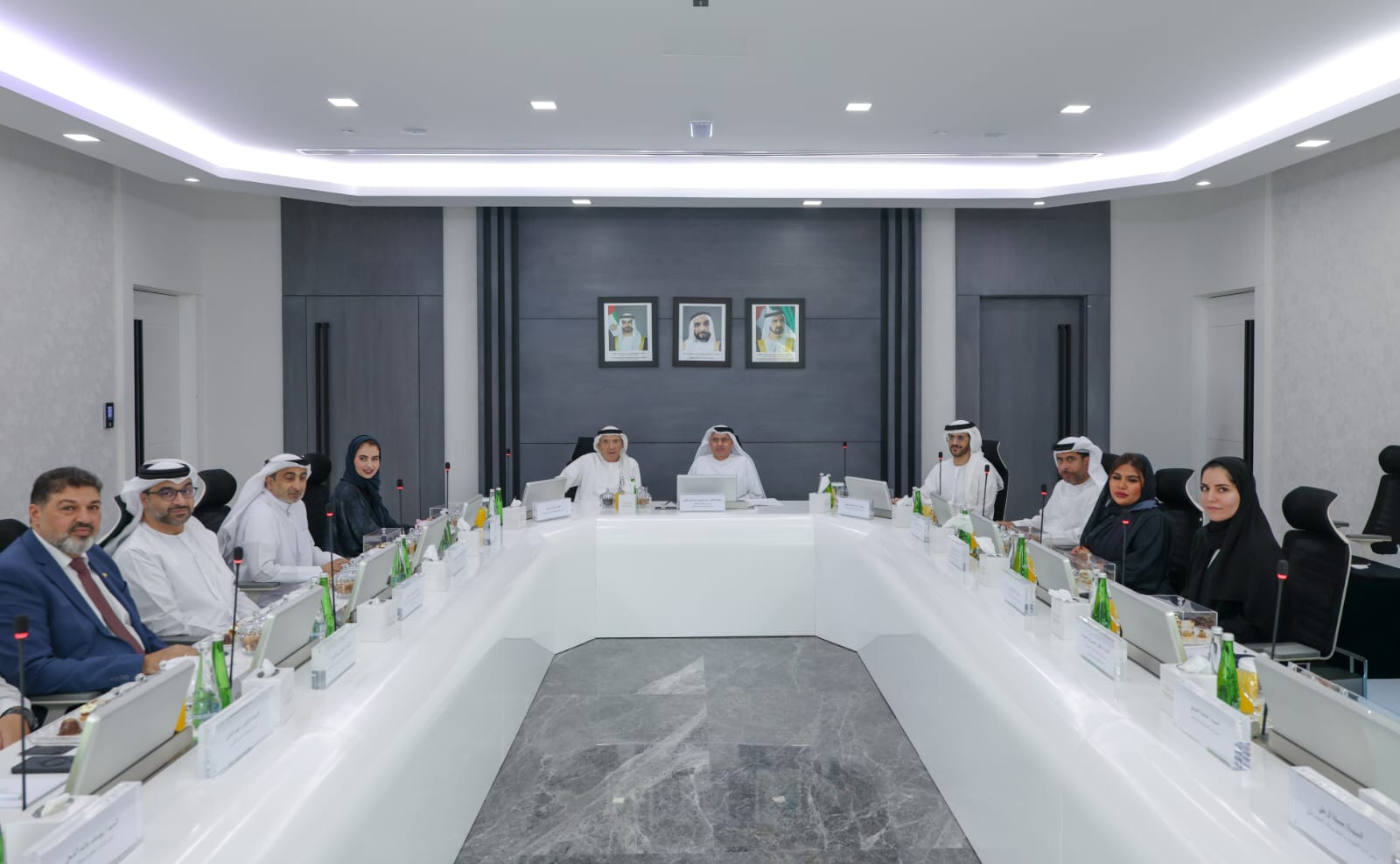
The Higher Education Committee recently held its seventh meeting at the headquarters of the Ministry of Higher Education and Scientific Research in Dubai, chaired by H.E. Dr. Abdulrahman Al Awar, Minister of Human Resources and Emiratisation and Acting Minister of Higher Education and Scientific Research. The meeting was attended by several Committee members, Ministry officials, representatives of federal higher education institutions and relevant working teams.
The meeting addressed several key areas, most notably new legislation and regulatory decisions governing the UAE’s higher education system; university registration and admissions results for the 2026–2027 academic year; the development of the higher education data ecosystem and the real-time connectivity project between the Ministry and higher education institutions; and the latest developments relating to the UAE Award in Higher Education.
The meeting was attended by H.E. Zaki Anwar Nusseibeh, Chancellor of United Arab Emirates University; H.E. Shamma bint Suhail Al Mazrui, Minister of Community Empowerment and President of Zayed University; H.E. Dr. Faisal Al Ayyan, President and CEO of the Higher Colleges of Technology; H.E. Amna Al Saleh, Assistant Undersecretary for Curriculum and Assessment Sector at the Ministry of Education; H.E. Dr. Ahmed Sultan Al Shoaibi, Undersecretary of the Ministry of Higher Education and Scientific Research; H.E. Shayma Alawadhi, Undersecretary of Labour Market Development and Regulation at the Ministry of Human Resources and Emiratisation; H.E. Shihab Abu Shihab, Director-General of the Advanced Technology Research Council; H.E. Professor Ahmed Ali Alraeesi, Vice Chancellor of United Arab Emirates University; Professor Mohsen Murad Sherif, Deputy Vice Chancellor for Academic Affairs; and Professor Omar Al Fandi, Acting Deputy Vice Chancellor of Zayed University and Dean of the College of Technological Innovation, in addition to a number of Ministry leaders.
H.E. Dr. Abdulrahman Al Awar affirmed that the meeting forms part of ongoing efforts to develop the UAE’s higher education and scientific research system, strengthen its governance and enhance its efficiency and performance in line with national priorities and the rapid transformations taking place across economic sectors and the labour market.
He said: “We continue to work towards consolidating an integrated and flexible higher education system that is aligned with national priorities and underpinned by effective governance, quality assurance of educational outcomes, efficient legislative and regulatory frameworks, oversight, and stronger integration between higher education institutions and various economic sectors. We also seek to harness the latest artificial intelligence technologies in support of the higher education system.”
The meeting also reviewed progress in implementing the recommendations of the sixth meeting, most notably the significant improvement in the quality of data submitted by federal higher education institutions since the launch of the Data Quality Dashboard. It also reviewed the findings of joint field visits conducted by the Ministry of Higher Education and Scientific Research, in collaboration with the Ministry of Human Resources and Emiratisation, to a sample of practical training providers during the summer semester, to assess the effectiveness of training and the soundness of the procedures followed.
Latest Developments of the UAE Award in Higher Education
The meeting reviewed the latest developments relating to the first edition of the UAE Award in Higher Education, launched by the Ministry under the patronage of H.H. Sheikh Abdullah bin Zayed Al Nahyan, Deputy Prime Minister, Minister of Foreign Affairs and Chairman of the Education, Human Development and Community Council. The award aims to recognise excellence and innovation in higher education and scientific research, highlight leading models that contribute to the development of the education system and enhance students’ readiness for the labour market.
The award comprises four main categories covering leading universities and higher and vocational education institutions; transformational higher education projects; higher education pioneers; and impactful higher education partners, with 18 subcategories. Its governance is overseen by a technical committee responsible for managing technical aspects and developing the criteria, evaluation and judging committees, and a supervisory committee responsible for oversight and approval.
Updating the Legislative and Regulatory Framework
The Committee discussed the impact of Cabinet resolutions issued during 2026 to regulate the higher education and scientific research sector, in implementation of the Federal Decree-Law on Higher Education and Scientific Research. These include Cabinet Resolution No. 104 of 2026 on the National Framework for Licensing Higher Education Institutions; Resolution No. 92 of 2026 on Review Fees for Higher Education Institutions and Technical and Vocational Education and Training Institutions; Resolution No. 103 of 2026 on Fees and Financial Guarantees Related to Services Provided by the Ministry; and Resolution No. 143 of 2026 on the Regulations of Violations, Penalties and Administrative Measures Related to the Ministry’s Mandates and Services.
The meeting also discussed the draft National Framework for Classification, Performance Quality and Oversight of Higher Education Institutions, which forms part of the new regulatory frameworks. As part of efforts to raise awareness of the resolutions and regulatory frameworks, the Ministry has held three dialogue sessions and two workshops, attended by 566 officials and representatives of higher education and technical and vocational education and training institutions, as well as training centres across the UAE.
Enhancing the Student Journey
The meeting reviewed the student registration service through the National Unified Registration and Admission Platform for Higher Education Institutions, which forms part of the unified digital higher education gateway, EduHub. The platform aims to simplify higher education enrolment procedures and enhance the customer experience. It has reduced the number of registration steps from eight to three — a 62% reduction — while cutting service completion time from 10 minutes to three minutes, representing a 70% reduction.
The platform draws on three official data sources, eliminating the need for customers to submit documents. It automatically reads students’ data and recommends the most suitable academic programmes from more than 1,000 programmes, while also enabling students to track their applications through to university admission.
The meeting also highlighted university admissions for the first semester of the 2026–2027 academic year, focusing on the platform’s role in expanding students’ opportunities to access higher education, as well as the effectiveness and flexibility of university admissions policies and criteria.
10/19/2026